“The art of medicine consists of amusing the patient while nature cures the disease.”
~Voltaire (1694 – 1778)
The thing with herbal healing that often gets overlooked is its role in providing immediate access to comfort and cures of the annoying little everyday things. How many wasted hours are spent trying to access services or controlled medications when those little rashes or styes could have been immediately addressed with the herbal medicine chest in one’s own home?

My family has always handled these kinds of things without the added stress or delay of “going in.” We keep a supply of herbal medicines for many purposes. The most significant is a group of infection fighters like golden seal, Oregon grape root, olive leaf, wild oregano oil, eucalyptus essential oil, and a patented silver nanoparticle product that has been confirmed safe by the FDA because it does not lead to the build-up of toxic silver levels in the body the way that colloidal silver does (Olerich, 2009).
When you want to tackle an infection without antibiotics, it requires a hard-hitting approach. You must use multiple naturopathic anti-infectives, alternating them every hour until the symptoms break, then continuing to take them three-four times a day for a good week to ten days. It’s a hassle of its own kind, but one that our family and Mom’s clients found more palatable than waiting in pain for an appointment and having our immune systems challenged by over-use and side effects of antibiotics. This is especially important to people like Mom who suffer from systemic candida overgrowth and / or non-alcoholic liver disease. In Mom’s case, long-term workplace exposure to industrial and salon chemicals destroyed her liver, immune system, and ability to tolerate other common substances like food dyes and additives, perfumes, synthetic fibers, or household cleaning products. Today’s term for the condition is multiple chemical sensitivities. Mom turned her home into a toxin-free haven and at its worst, she stayed inside for months on end, much like David Vetter (1971 – 1984), who became known as The Bubble Boy due to his genetic condition called Severe Combined Immunodeficiency.
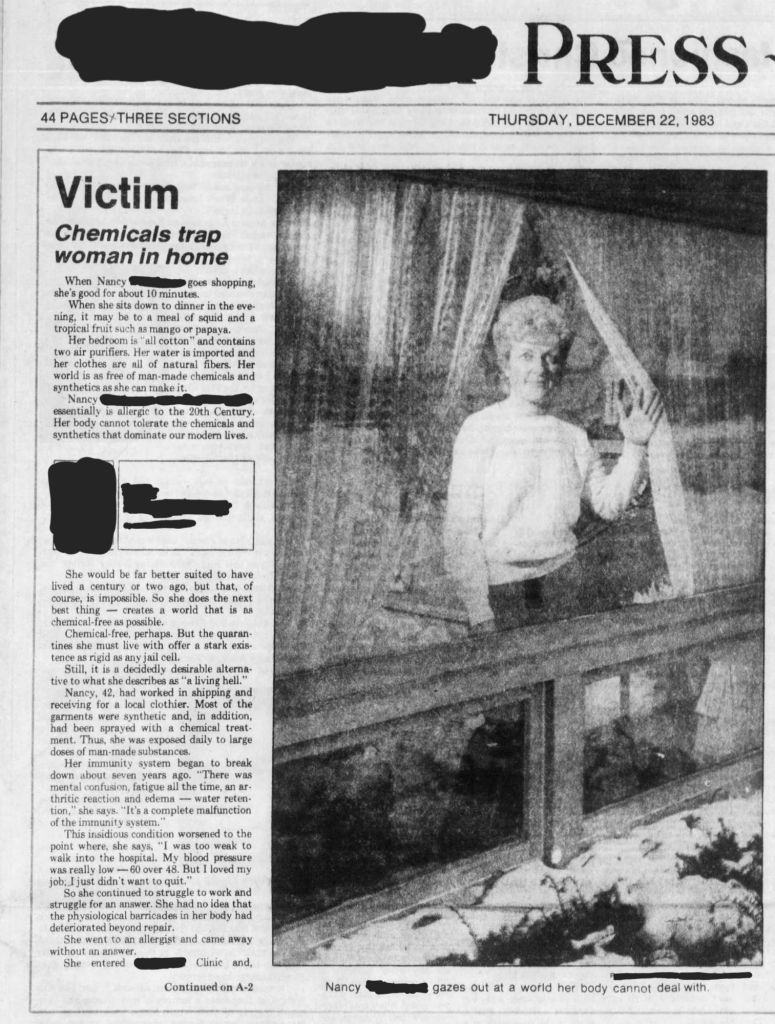
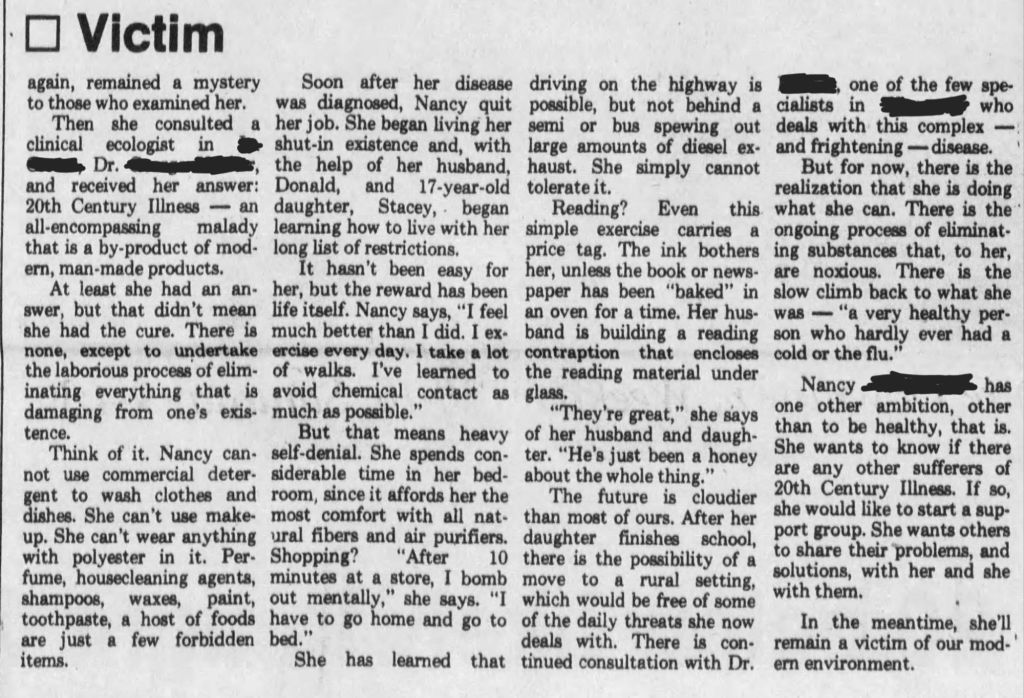
Mom was diagnosed with only a five percent liver function in 1982 – 1983. With a compromised liver, individuals often have difficulty metabolizing drugs. Inadequate drug excretion and persistently elevated serum drug levels can lead to drug toxicity and further damage to the liver and other vital organs (Rowden, 2023). This illustrates the importance for some people to have safe alternatives to drugs when dealing with everyday health concerns. Of course, we know that the liver is a regenerative organ that can regrow even after 90% of it has been removed (Reynolds, 2021). Mom worked tirelessly for the rest of her life to reduce further liver damage (through avoidance of toxins) and to support her body nutritionally to rebuild liver function. For her, the herbal medicine provided more than just a treatment path for everyday ailments but a total nutritional approach to feed her body the micronutrients that could support self-healing. Evidence of the efficacy of her approach is in the lab results over time. Without prescriptions, and in her own home, after leaving the hospital against medical advice in 1983, her liver enzymes and other functional lab results went from lethal levels to a partly normalized status, which allowed her to live another forty years, albeit with serious restrictions.
Using Mom’s principles and knowledge of other herbalists’ teachings, I too have successfully treated varicose veins, full-blown mastitis, mild UTIs, stomach issues, hernias, pink-eye, cuts and bruises, anemia, and many other things for myself, the kids, pets, friends, and my own clients in a perinatal clinic. I’m not claiming any status here; it’s the opposite. The stories demonstrate that each of us can go to our own plant medicines and pick out what will help for many things without having to engage with the broken parts of the medical system for non-emergency situations.
Mom disengaged from the medical system because it reached a point where no further help could be offered for her autoimmune disease, and the experimental, “last resort” drugs were known to cause more harm than benefits. She did not live a risky existence for injuries and severe illnesses like heart disease, diabetes, or cancer, so she did not have to rely on medicine for many things, but she did occasionally need its help, such as for thyroid medication in later life and to remove her gallbladder when it was over-wrought with painful stones.
That is the beauty of self-directed, home-remedies as basic first-line healthcare. We can use the accessible plant medicines for the things that are less serious or beyond medical help and turn to allopathic medicine for things that do not respond to or should not be handled by home remedies. There is a surprisingly long list of things that can be helped on our own. The two drawbacks I’ve experienced are taking herbal treatments before seeing a medical doctor, which sometimes reduces symptoms and prevents the physician from identifying the problem -or- the plant medicine is contraindicated with the proposed drugs and a decision about stopping the herbs vs. not starting the drugs has to be made.
I spent the past several weeks combing through archival materials about ancestral midwives and found that herbal and home remedies used before the Modern era were effective for treating severe conditions beyond simple maladies. Ancestral healers treated their neighbors’ and friends’ serious issues with little more than the local plants of their regions. One midwife, an African American woman who went by Aunt Mary Ann Menard (née Labuche) (ca. 1767 – 1833) was known to use herb teas to cure people who were beyond the help of local surgeons. She is known for saving the life of her granddaughter, who was brutally assaulted in infancy with a resultant skull fracture and exposed area of her brain. Aunt Mary Ann covered the wound with a silver coin, nursed her through the injuries, and the child lived to her 80s. She wore a little protective cap over the hole in her skull for life (Milwaukee Sunday Journal, 1925).
Does this mean today’s medical methods are wrong? No, indeed, they’re part of a necessary, multidisciplinary approach to sickness and wellness. Modern medicine is especially effective in dealing with acute trauma and certain well-understood diseases. But as long as there are medical mysteries, barriers to access, and extreme adverse effects of certain treatments, we need adjuncts and alternatives. The key is in knowing which things need urgent high-tech attention vs. time, comfort, and nourishment.
One of the tenets of plant medicine is that it offers micronutrients that foster the body’s ability to self-correct. I love the Voltaire quote, “The art of medicine consists of amusing the patient while nature cures the disease.” It’s also important to be clear about when to shift strategies in either direction. That’s achieved by having a planned if/then decision flow with contingency steps. If the UTI symptoms persist more than 24 hours after starting home treatments, then we will call the general practitioner. If the oncology team says they can offer only palliative measures, then we will look into plant based cures and support. If the wound is bleeding out, then we will skip home remedies and seek emergency services. If the wait for treatment is many days, then we will initiate something at home while waiting.
Of course, I come to these ideas from a standpoint of privilege; I’ve been blessed with education, housing, sanitation, high quality herbs, health and herbal training, people who shared their knowledge, etc. Someone with fewer resources may not have the same results. Those of us who can, should share the knowledge and resources, and all of us should have an herbal medicine kit at hand and be trained on how to use it. Stay tuned for part II, where I’ll discuss products to keep in stock at home.
—–
References
Milwaukee Sunday Journal. (1925, November 29). Woman first state “doctor”: Settlers long healed by herb remedies of Aunt Mary Ann.
Olerich, Karen. (2009). Silver shield with aqua sol technology: Are you confused about colloidal silver? A Renewed Health. Colorado Springs, CO.
Reynolds, Susan. (2021, March 9). Cells that maintain and repair the liver identified. NIH Research Matters. Accessed on April 15, 2024, from https://www.nih.gov/news-events/nih-research-matters/cells-maintain-repair-liver-identified#:~:text=The%20liver%20has%20a%20unique,beyond%20the%20point%20of%20repair.
Rowen, Adam. (2023, August 4). The role of the liver in drug metabolism [blog post]. Medical News Today. Accessed on April 15, 2024, from https://www.medicalnewstoday.com/articles/liver-and-drug-metabolism
 Nancy's Sunshine, LLC